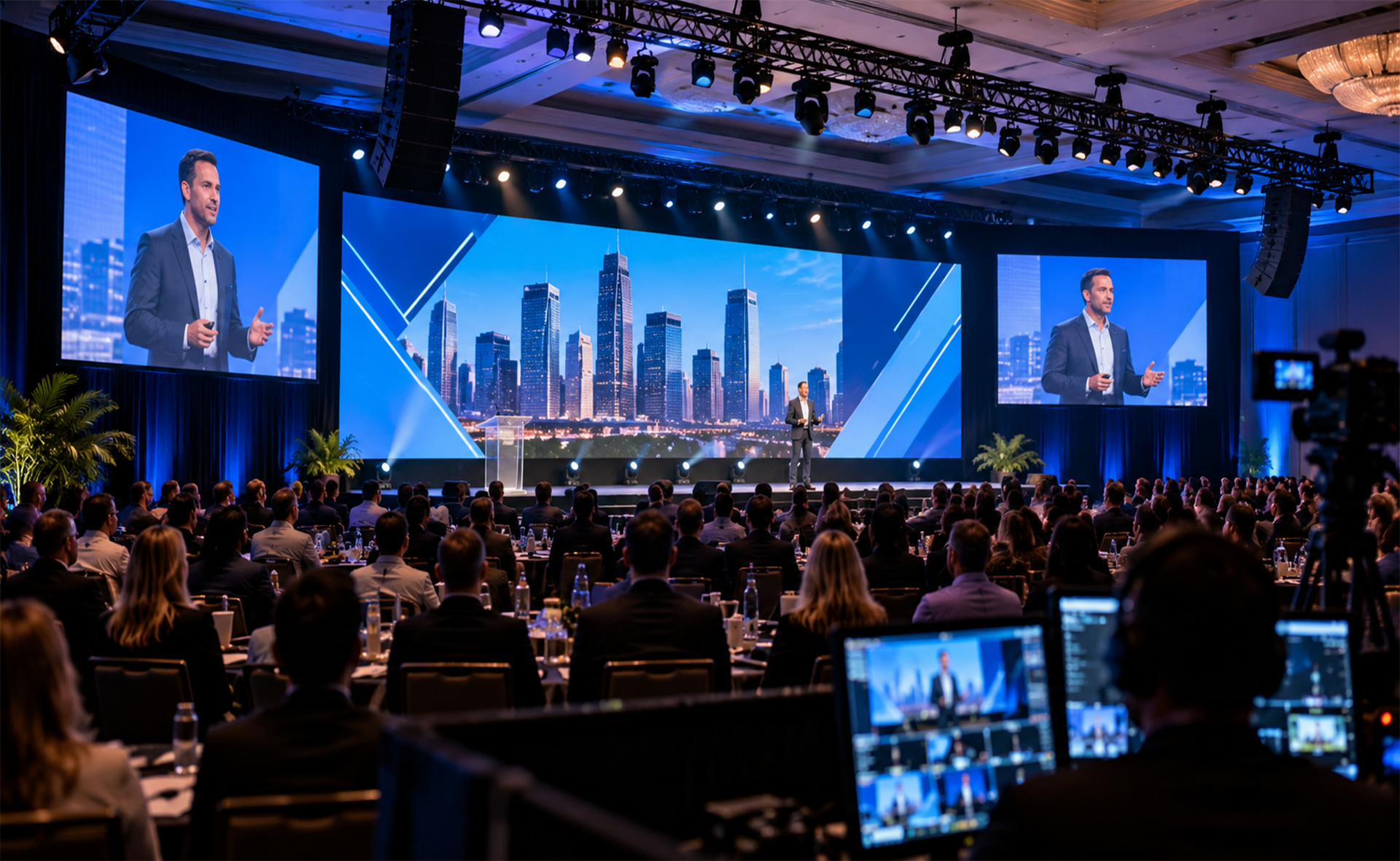

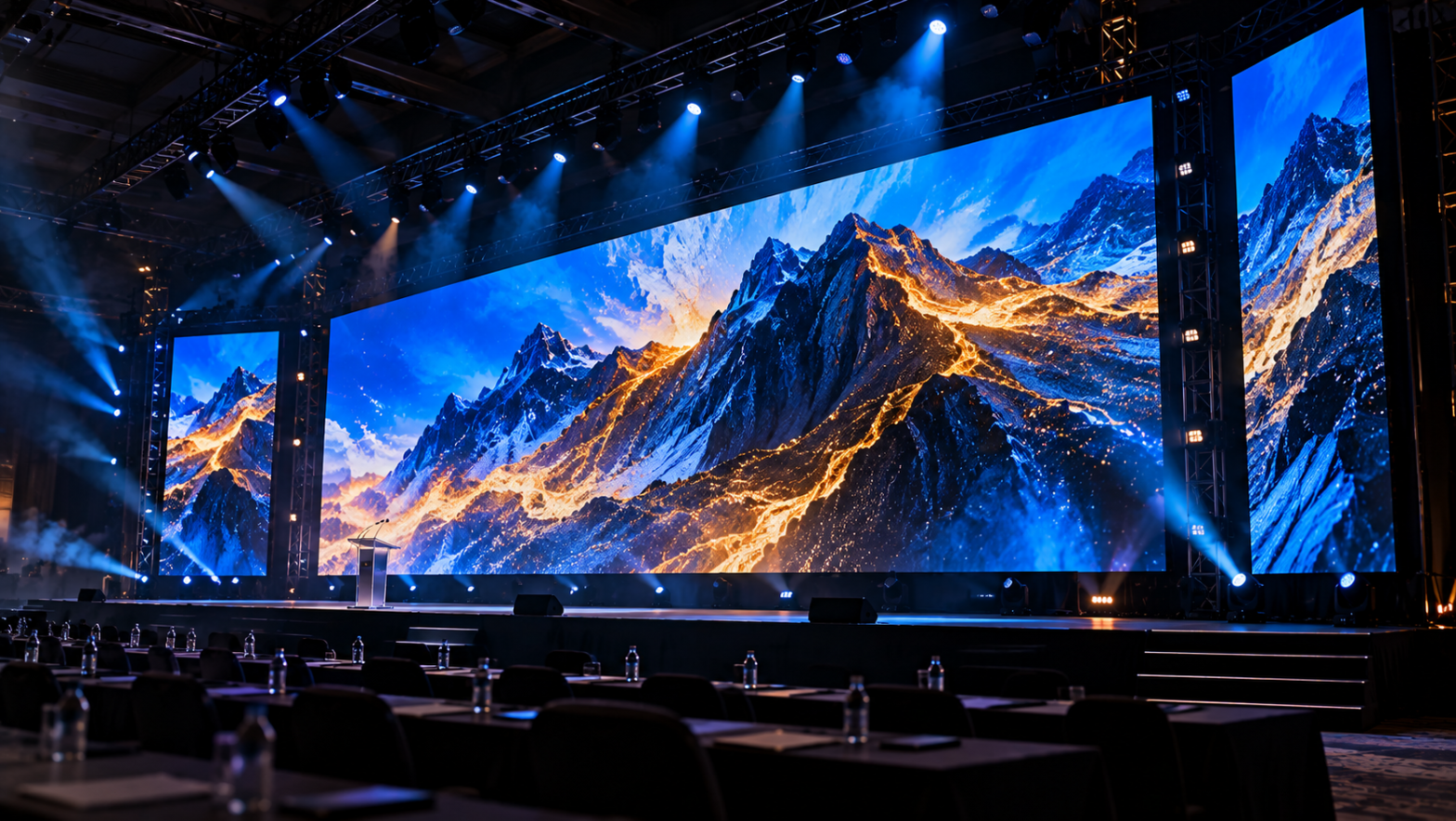
LED video walls have become one of the most popular display solutions for conferences, corporate events, concerts, festivals, trade shows, general sessions, product launches and outdoor events.
They can be built in different sizes and shapes, produce extremely bright images, work indoors or outdoors, and can display everything from PowerPoint presentations and videos to live camera feeds.
But what exactly is an LED wall? What does 2.9mm pixel pitch mean? How is a 20-foot-wide screen built from individual panels? What’s the difference between a ground-stacked and flown LED wall? And how much power does one actually require?
In this guide, we’ll break down the technology behind professional LED video walls and explain the factors that determine which type of LED screen is right for an event.
What Is an LED Video Wall?
An LED video wall is a large digital display made from multiple smaller LED panels, sometimes called cabinets or tiles, connected together to create one continuous screen.
Unlike a projector and projection screen, an LED wall produces its own light. Thousands—or even millions—of individual LEDs work together to create the image you see.
One of the biggest advantages of this modular design is scalability.
Instead of manufacturing one enormous screen, individual panels can be connected horizontally and vertically. That allows a production company to build a screen specifically for the event.
A smaller corporate meeting may need a relatively compact LED wall behind the stage, while a conference or concert may require a screen stretching 20, 30 or even 50 feet across.
The same basic technology makes both possible.
How Does an LED Screen Actually Work?
 To understand an LEDwall, start with the smallestpart of the image: the pixel.
A pixel is one tiny point of color within a digital image. On a typical direct-view LED display, pixels use red, green and blue light to reproduce a huge range of colors.
From there, the system gets progressively larger:
LEDs create pixels → pixels form modules → modules make up LED panels → panels connect together to create the complete video wall.
Behind the display, additional electronics control what every pixel is supposed to do.
A video processor receives a signal from a source such as a computer, media server, presentation system or video switcher. That information is distributed to the LED panels, telling the pixels what colors and brightness levels they should display.
When all of those pixels work together, the audience sees one seamless image instead of hundreds of individual components.
What Is Pixel Pitch?
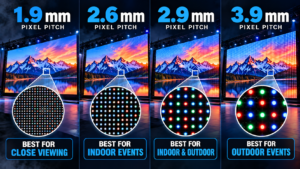 Pixel pitch is one of the most important specifications when selecting an LED wall.
You’ll commonly see numbers such as:
1.9mm
2.6mm
2.9mm
3.9mm
4.8mm
These numbers aren’t referring to the physical size of the panel.
Pixel pitch is the distance, measured in millimeters, from the center of one LED pixel to the center of the next.
A 1.9mm LED panel therefore places its pixels closer together than a 3.9mm panel.
That difference has a major effect on image quality.
The smaller the pixel pitch, the more pixels can fit within the same physical area. More pixels mean greater pixel density and the ability to produce a more detailed image, particularly when viewed from close distances.
Is a Smaller Pixel Pitch Always Better?
Technically, a smaller pixel pitch provides greater pixel density, but that doesn’t necessarily make it the right choice for every event.
Viewing distance matters.
Imagine standing three feet away from a giant outdoor concert screen. At that distance, you may be able to distinguish individual pixels.
Move 100 feet away and those same pixels visually blend together.
That’s why an LED wall being viewed from relatively close range—such as a corporate conference screen directly behind a presenter—may benefit significantly from a fine pixel pitch.
At a festival where the audience is much farther away, a larger pixel pitch may still produce an excellent image.
There are several formulas used throughout the industry to estimate viewing distance, but they should be treated as guidelines rather than absolute rules. Content, screen size, audience position and the application itself all matter when selecting an appropriate pixel pitch.
Screen Size and Resolution Are Not the Same Thing
This is one of the most important concepts to understand about LED walls.
Physical screen size and screen resolution are two different things.
A screen may physically measure 16 feet wide, but that doesn’t automatically mean its resolution is 1920 × 1080.
Every LED panel contains a specific number of pixels.
When panels are connected, their resolutions are added together.
For example, imagine an LED panel with a resolution of 168 × 168 pixels.
If we build a wall:
10 panels wide × 6 panels high
the complete LED canvas would be:
1,680 × 1,008 pixels
The exact numbers depend on the LED product being used, but the principle is always the same.
This is why professional event content should ideally be designed around the actual pixel dimensions of the LED canvas.
How Is the Physical Size of an LED Wall Determined?
Professional rental LED panels are manufactured in standardized cabinet sizes.
A very common format is approximately:
500mm × 500mm
or roughly:
19.7 inches × 19.7 inches
Other formats, including 500mm × 1000mm cabinets, are also widely used.
Because the panels are modular, screen dimensions are created by adding additional cabinets.
For example, a wall built 10 panels wide using 500mm panels would be approximately 5 meters wide.
That modular system allows event designers to create traditional 16:9-style screens, extremely wide scenic displays, vertical screens, side screens and other custom configurations.
Aspect Ratio and LED Wall Content
Most people are familiar with the 16:9 aspect ratio used by televisions, laptops and standard HD video.
LED walls don’t necessarily have to follow that shape.
Corporate events increasingly use ultra-wide LED walls stretching across an entire stage. Concerts may use tall vertical LED columns. Trade show exhibits may incorporate multiple displays into scenic structures.
The advantage is creative flexibility.
The challenge is content.
If a standard 16:9 PowerPoint presentation is sent to an extremely wide LED wall without proper planning, it may not fill the screen correctly.
That’s why the LED wall’s physical dimensions, pixel resolution and event content should be considered together during the design process.
Ground-Stacked LED Walls
One common method for installing an LED wall is a ground-stack configuration.
Instead of hanging the screen from the building or overhead truss, the LED wall is supported from the floor using a purpose-built structural system.
The panels are assembled on top of the support system and secured according to the manufacturer’s requirements.
Professional ground-support systems can include base structures, rear supports, adjustable leveling components and ballast requirements depending on the design. Manufacturers specify maximum heights, loads and other limitations for their particular systems.
Ground stacking can be a great solution when overhead rigging isn’t available or when the event design doesn’t require the screen to be suspended.
But a ground-supported LED wall still requires proper planning.
The weight of the screen, height, support structure, floor conditions and applicable engineering requirements all need to be considered.
Flown or Rigged LED Walls
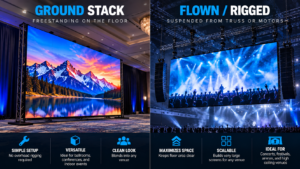 The second major installation method is a flown LED wall.
Instead of supporting the wall from underneath, the LED panels are suspended from an approved overhead structure using manufacturer-rated rigging hardware.
Depending on the venue and production design, this may involve truss, motors, rigging points and dedicated LED hanging bars.
Professional LED rigging systems are specifically designed to transfer the weight of connected cabinets into the overhead support system. Some manufacturers even design the same rig bars to work in either flown or ground-supported configurations.
Flying an LED wall can create a very clean look because support structures don’t need to occupy as much floor space behind the screen.
However, the venue must have appropriate rigging capabilities, and the complete load—including the LED panels, rigging hardware and supporting equipment—has to be considered.
Rigging should always be handled according to the equipment manufacturer’s specifications, venue requirements and applicable engineering and safety practices.
How Much Does an LED Wall Weigh?
LED walls can become surprisingly heavy.
A single modern rental panel may be manageable by one technician, but a large wall can contain dozens—or even hundreds—of panels.
Consider a hypothetical wall containing 60 panels.
If each panel weighs 20 pounds:
60 × 20 lbs = 1,200 lbs
And that’s only the LED panels.
The complete system can also include:
- Rigging bars
- Ground-support hardware
- Truss
- Motors
- Cabling
- Power distribution
- Ballast or other structural components
This is one reason the final dimensions of an LED wall matter well beyond appearance.
Increasing the size of the screen also increases its weight, power requirements, transportation requirements and installation complexity.
How Much Power Does an LED Wall Use?
Large LED walls require significant electrical planning.
Each cabinet consumes power, and that demand multiplies as panels are added.
Manufacturers generally provide electrical specifications that production teams use to determine the power requirements for the complete screen.
Another important distinction is maximum power consumption versus typical or average consumption.
An LED display showing extremely bright white content may draw considerably more power than the same screen displaying darker material. Brightness settings also affect consumption.
Different LED products can have very different power requirements. For example, Planar lists different models within one LED family at 68 watts and 135 watts per display unit depending on brightness and configuration, illustrating why the actual manufacturer’s specifications must be used rather than assuming every LED panel consumes the same amount of electricity.
For larger systems, dedicated power distribution may be required.
Before the screen is installed, the production team should know how many panels will be used, their electrical requirements and what power is available at the venue.
Indoor vs. Outdoor LED Walls
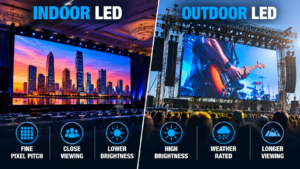 Not every LED panel is designed for the same environment.
Two major differences between indoor and outdoor LED systems are brightness and environmental protection.
Indoor LED
Indoor screens generally don’t have to compete with direct sunlight.
They are commonly used for:
- Conferences
- General sessions
- Corporate meetings
- Trade shows
- Galas
- Ballrooms
- Houses of worship
- Indoor concerts
Fine pixel pitches are especially useful in indoor applications where attendees may be relatively close to the screen.
Outdoor LED
Outdoor screens face a completely different environment.
They may need to operate in daylight while also being exposed to dust, humidity and changing weather conditions.
Outdoor LED products are therefore typically designed with much higher brightness and appropriate environmental protection.
For comparison, professional product families can range from around 1,000 nits for lower-ambient-light indoor applications to several thousand nits for high-brightness outdoor displays. Some outdoor models carry ratings such as IP65 for environmental protection.
The exact brightness and weather rating required depends on the product, installation and environment.
What Are Nits?
LED display brightness is commonly measured in nits.
Simply put:
More nits = a brighter display.
A screen inside a dark ballroom doesn’t need the same brightness as a screen operating outside in daylight.
In fact, an LED wall that’s excessively bright indoors can be uncomfortable for the audience and problematic for cameras.
Outdoor displays, on the other hand, need enough brightness to remain visible against strong ambient light.
This is why simply choosing the brightest available screen isn’t necessarily the goal.
The objective is to select a display capable of producing the appropriate brightness for its environment.
LED Walls and Cameras: Why Refresh Rate Matters
An LED wall can look perfectly normal to the human eye but look completely different through a camera.
You may have seen video footage where an LED wall appears to have:
- Horizontal lines
- Flickering
- Scanning patterns
- Dark bands
- Strange artifacts
Several factors can contribute to this, including the LED system’s refresh rate, camera shutter settings, frame rate and processor configuration.
This becomes especially important at corporate events, livestreams, broadcasts and concerts where cameras are pointed directly toward the LED wall.
For an event using image magnification (IMAG), recording or livestreaming, the LED system and camera system should be considered together rather than as completely separate pieces of equipment.
What Happens if an LED Pixel Goes Out?
LED walls are modular not only in their overall construction but often internally as well.
Individual cabinets typically contain smaller LED modules along with receiving cards, power supplies and other electronics.
Depending on the panel design, technicians may be able to replace an LED module without replacing the entire cabinet.
Professional rental equipment is also inspected and tested so problems can be identified before the equipment arrives on site.
For important productions, technicians may carry spare components or panels so a problem can be addressed without replacing an entire video wall.
How Is an LED Wall Built at an Event?
A large LED wall doesn’t simply arrive at the venue as one giant screen.
The installation happens in stages.
First, the cases containing the LED panels and supporting equipment are positioned near the installation area.
The crew then builds the appropriate ground-support or overhead rigging system.
Panels are connected together one by one, carefully aligned so the finished display appears seamless.
Power and data connections are distributed throughout the wall.
The LED processor is configured for the exact panel layout.
Video signals are connected and mapped to the correct portion of the display.
Finally, the entire wall is tested before the event begins.
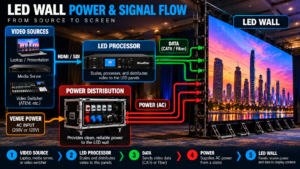 A simplified workflow looks like this:
Unload → Build support/rigging → Install panels → Connect power → Connect data → Configure processor → Map content → Test → Show ready
Behind what appears to the audience as one simple screen is an entire system of structural, electrical and video technology.
What Determines the Cost of an LED Wall?
There isn’t one universal price for an LED video wall.
The final cost depends on much more than the physical screen.
Major factors include:
- Total screen size
- Number of LED panels
- Pixel pitch
- Indoor or outdoor panels
- Video processing
- Ground support or rigging
- Motors and truss when required
- Labor
- Transportation
- Power distribution
- Setup and teardown time
- Technicians
- Content requirements
- Video switching
- Cameras and IMAG
- Venue requirements
A smaller ground-supported LED wall in a ballroom is a very different production from a large outdoor wall that requires extensive support, power distribution and weather-rated equipment.
That’s why professional LED wall pricing normally begins with understanding the event rather than simply quoting a price per square foot.
Choosing the Right LED Wall for Your Event
Selecting an LED wall isn’t simply a matter of choosing the biggest screen or the smallest pixel pitch.
A properly designed system considers the entire event.
At ATH Productions, some of the questions we consider include:
How large is the venue?
How far will the closest and farthest audience members be from the screen?
Will the event be indoors or outdoors?
What content will be displayed?
Will cameras be shooting the LED wall?
Does the venue allow overhead rigging?
What power is available?
What screen dimensions make sense for the stage?
Does the content need a traditional 16:9 screen or a custom LED canvas?
What is the overall production budget?
Answering those questions helps determine the appropriate screen size, pixel pitch, brightness, processing, support method and production infrastructure.
LED Video Walls Are More Than Just a Screen
To the audience, an LED wall may look like one enormous television.
Behind the scenes, it’s actually a carefully engineered system made up of hundreds of interconnected components.
Pixels create the image.
Panels create the canvas.
Processors distribute the video.
Power systems keep everything running.
Rigging or ground-support systems hold thousands of pounds of equipment safely in position.
And technicians make sure all of those systems work together.
That’s what makes LED video technology so versatile. The same fundamental components can create a clean presentation screen for a corporate conference, an ultra-wide backdrop for a general session, a massive concert display or a daylight-visible outdoor video wall.
At ATH Productions, we design and provide professional LED video wall systems as part of complete event productions and equipment rentals. From determining the right pixel pitch and screen dimensions to video processing, power, rigging and installation, our team can help build an LED solution around the specific needs of your event.
Planning an event that needs an LED video wall? Contact ATH Productions to discuss your venue, screen size, content and production requirements.