

In professional live sound, few names are as recognized as L-Acoustics.
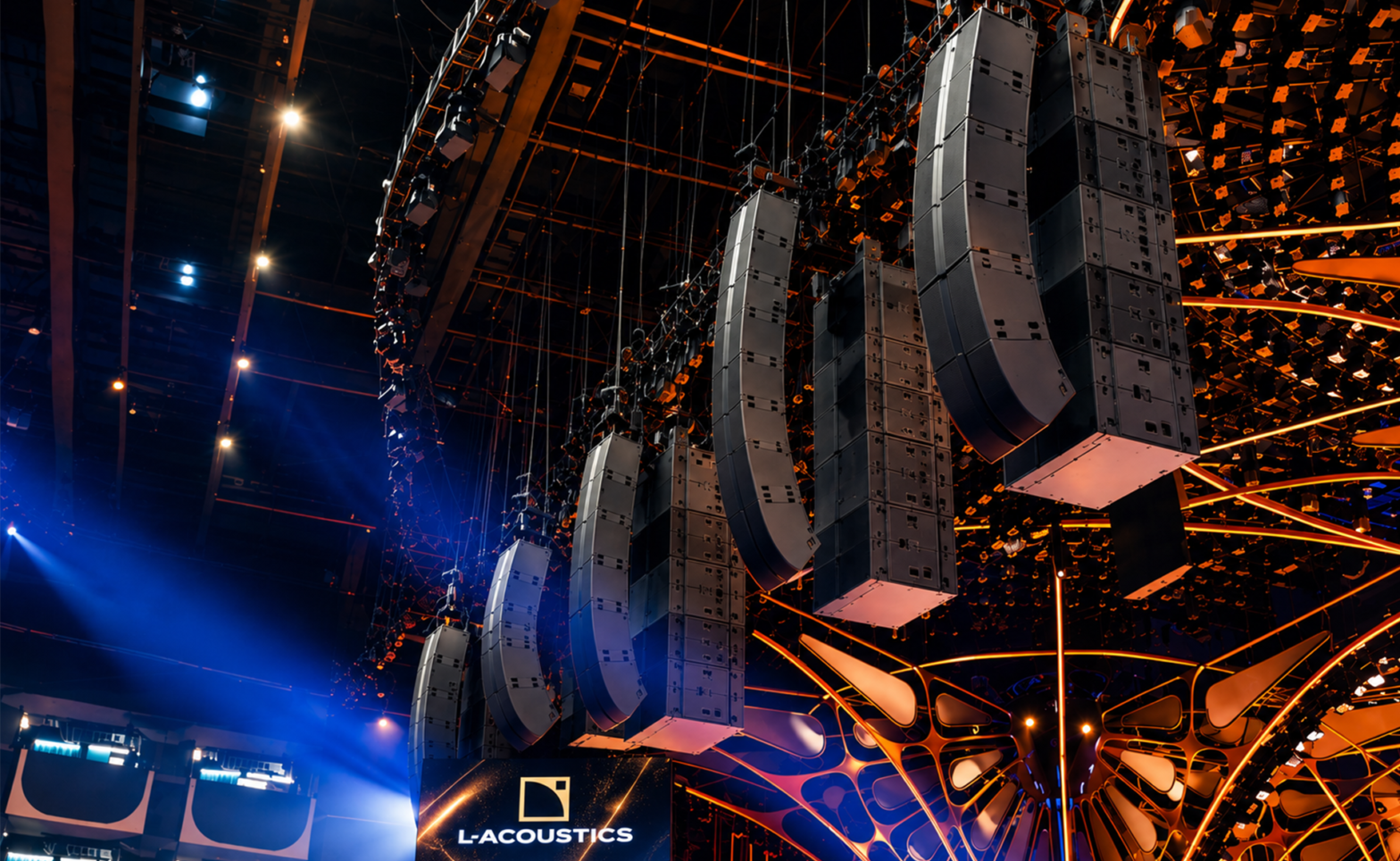
From concert tours and music festivals to arenas, theaters, corporate productions and large-scale outdoor events, L-Acoustics sound systems are used around the world to deliver powerful, controlled and consistent audio experiences.
But what makes an L-Acoustics system different isn’t simply how loud it can get.
L-Acoustics approaches professional audio as a complete ecosystem. Loudspeakers, subwoofers, amplification, digital signal processing, networking, system modeling and control all work together with one objective: put the right sound in the right place and deliver a consistent experience throughout the audience.
Understanding that approach helps explain why L-Acoustics has become such an important name in modern live sound.
The History Behind L-Acoustics
L-Acoustics was founded in 1984 by physicist Dr. Christian Heil, who brought a physics-driven approach to loudspeaker and sound-system design.
One of the company’s most important breakthroughs came in 1992 with Wavefront Sculpture Technology (WST) and the introduction of V-DOSC.
This helped establish the modern line-source approach that would transform large-scale concert sound.
Rather than treating a group of loudspeakers simply as individual boxes producing more volume, a properly designed line-source system allows multiple elements to work together to create a controlled and predictable wavefront.
That concept remains fundamental to L-Acoustics systems today.
It’s About Coverage, Not Just Volume
One of the biggest misconceptions about large professional sound systems is that bigger speakers are simply there to make an event louder.
Output is important, but coverage, consistency and intelligibility are equally important.
Imagine an audience stretching hundreds of feet from a stage.
Someone standing near the front shouldn’t be overwhelmed while someone farther away struggles to hear the vocals. Audience members toward the sides should also receive a balanced listening experience rather than hearing an entirely different mix.
Professional sound-system design attempts to deliver consistent frequency response, intelligibility and impact throughout the listening area.
This is where system design becomes just as important as the equipment itself.
At the heart of L-Acoustics line-source systems is Wavefront Sculpture Technology, or WST.
WST provides a framework for designing arrays inwhich multiple loudspeaker elements operate together as a coherent source.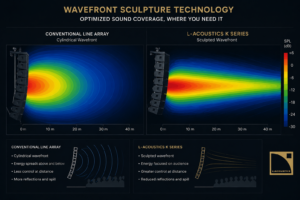
The number of loudspeakers, their positioning, angles and configuration all influence how acoustic energy is distributed throughout a venue.
Instead of simply pointing speakers toward a crowd and increasing the volume, engineers can design an array around the geometry of the audience.
For large concerts and festivals, where thousands of people may occupy an enormous area, that level of control becomes extremely important.
Panflex: Controlling Where the Sound Goes
Several L-Acoustics systems also incorporate Panflex technology.
Panflex allows engineers to adjust the horizontal directivity of compatible loudspeakers, adapting the coverage pattern to different audience layouts.
Why does that matter?
Because a narrow arena floor, a wide festival field, a theater and a corporate ballroom all have very different coverage requirements.
Controlling where acoustic energy is directed canhelp engineers cover the areas where people are actually listening while reducing unnecessary sound directed toward walls, stages or other areas where it isn’t needed.
The L-Acoustics K Series
The K Series includes some of the most recognizable L-Acoustics line-source systems.
Different models allow engineers to scale the PA according to audience size, throw distance, venue geometry, rigging requirements and the needs of the production.
K1
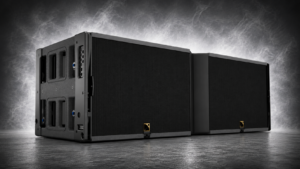 K1 represents large-format L-Acoustics sound reinforcement.
Designed for major productions requiring significant output and long-throw capability, K1 systems can be deployed for stadium concerts, major festivals and other extremely large events.
This is the scale of sound reinforcement required when an audience can number in the tens of thousands.
K2
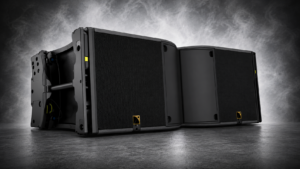 K2 combines large-format performance with considerable flexibility.
Its three-way design and adjustable Panflex horizontal directivity allow engineers to adapt the system to different audience geometries.
That combination of output, throw and controllable coverage makes K2 an extremely capable platform for concerts, festivals, touring productions and large outdoor events.
K3
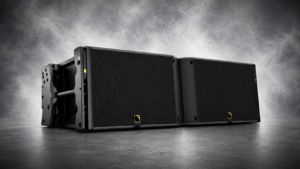 K3 brings many ofthe principles of the larger K Series systems into a more compact enclosure.
Its size can be particularly valuable for productions where weight, sightlines, rigging capacity or available space are important considerations.
And compact doesn’t mean small-event audio.
A properly designed K3 system can provide serious performance while reducing the physical footprint of the PA.
KARA II and KIVA II
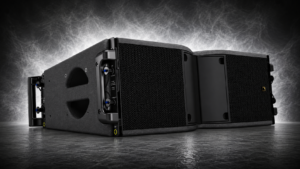
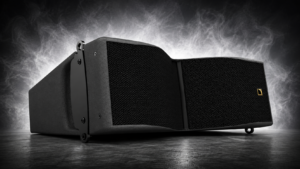 Systems such as KARA II and KIVA II extend the K Series into smaller formats.
These systems allow engineers to apply L-Acoustics line-source technology to productions where a large-format array may be unnecessary or physically impractical.
This gives sound designers a wide range of options rather than attempting to make one loudspeaker platform work for every event.
Subwoofers: Creating the Foundation
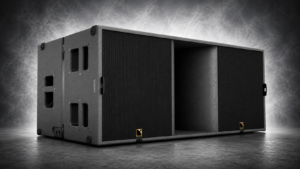 A powerful professional sound system also requires proper low-frequency reinforcement.
L-Acoustics offers multiple subwoofer platforms designed to integrate with its loudspeaker systems.
One of its best-known touring subwoofers is the KS28, a dual 18-inch system capable of extending into extremely low frequencies.
Those frequencies create much of the physical impact associated with concert sound—the kick drum you feel in your chest, the weight underneath a bass guitar and the deep electronic content found throughout modern music.
But professional subwoofer deployment involves more than placing a row of boxes in front of a stage.
Engineers can design subwoofer arrays to control how low-frequency energy is distributed throughout the venue. Depending on the application, this can include cardioid configurations and other techniques intended to improve low-frequency coverage while reducing unwanted energy in other areas.
A Series: Flexible Sound-System Design
Not every event needs a traditional line array.
The L-Acoustics A Series, including platforms such as A10 and A15, provides another approach to professional sound reinforcement.
These systems can be deployed individually or combined into different configurations depending on the application.
A Series loudspeakers can serve as primary systems for certain productions or provide supplemental coverage alongside larger systems.
For example, additional loudspeakers may be used for sidecoverage, front fills, delay positions or areas that cannot be effectively reached by the primary arrays.
This illustrates an important principle of professional system design:
The biggest loudspeaker isn’t always the correct loudspeaker.
The correct system is the one designed for the audience and the environment.
X Series and Stage Monitoring
L-Acoustics also manufactures compact coaxial loudspeakers within its X Series.
These systems can serve numerous roles, including stage monitoring, front fills, distributed audio and smaller standalone systems.
In live production, professional stage monitors allow performers to hear the information they need while engineers maintain control over the sound on stage.
Smaller loudspeakers can also become extremely important throughout a large system by filling areas that the main PA cannot effectively reach.
Amplification, Processing and Control
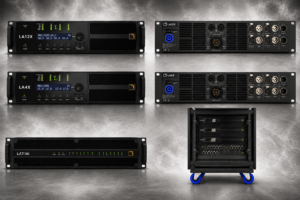 A professional L-Acoustics deployment is much more than a collection of speakers.
L-Acoustics uses dedicated amplified controllers that combine amplification with digital signal processing, loudspeaker presets, system protection, networking and control.
Platforms such as LA4X, LA12X and LA7.16 allow loudspeakers, amplification and processing to operate as part of an integrated system.
This is an important distinction.
The amplifier isn’t simply an unrelated device supplying power to a speaker. Amplification, processing, loudspeaker configuration and system control are designed to work together.
That gives engineers much greater control over how the complete sound system performs.
Soundvision: Designing the System Before It Is Built
One of the most powerful parts of the L-Acoustics ecosystem isn’t a loudspeaker at all.
It’s software.
Soundvision allows sound designers to model a venue and design an L-Acoustics system before the PA is physically installed.
Engineers can create a three-dimensional representation of the listening environment and evaluate factors such as audience coverage, loudspeaker positioning, array geometry and system configuration.
This becomes incredibly valuable on complex productions.
Rather than arriving at a venue and relying entirely on trial and error, a significant portion of the sound system can be engineered before the equipment ever leaves the warehouse.
For large productions, that preparation can improve performance and make installation considerably more efficient.
LA Network Manager: Controlling the System
Once an L-Acoustics system is deployed, LA Network Manager provides centralized configuration, control and monitoring of compatible L-Acoustics electronics.
Engineers can organize the system into groups, configure amplified controllers, adjust parameters and monitor the system through a networked environment.
On a large production containing main arrays, subwoofer systems, fills, delays and multiple amplifier locations, centralized control becomes extremely valuable.
It gives the audio team the ability to manage the PA as a complete system rather than as dozens of independent pieces of equipment.
L-ISA and Immersive Audio
L-Acoustics has also expanded beyond conventional left-and-right sound reinforcement with L-ISA immersive audio technology.
Traditional concert PA systems typically create much of the listening experience from left and right loudspeaker arrays.
Immersive audio provides sound designers with another approach, allowing audio elements to be positioned within a spatial environment.
For concerts, theater, experiential productions and other creative applications, this creates possibilities that extend beyond conventional stereo sound reinforcement.
It represents another example of how professional audio continues to evolve beyond simply making a system louder.
Built for Professional Production
Professional touring equipment lives a difficult life.
Loudspeakers are repeatedly transported, loaded onto trucks, rigged above stages, deployed outdoors and moved from venue to venue.
Construction therefore matters.
Professional L-Acoustics touring systems use robust enclosures, protective grilles, integrated rigging components and hardware engineered for repeated professional deployment.
Rigging is itself a critical part of large-scale audio.
A flown array may contain numerous loudspeaker cabinets suspended above a stage or audience area. Proper engineering, load calculations, approved hardware and experienced personnel are essential components of a safe professional deployment.
Why Professional System Design Matters
Owning high-end loudspeakers doesn’t automatically produce a great-sounding event.
How the system is designed and deployed matters just as much.
Professional audio engineers consider factors including:
- Venue dimensions
- Audience geometry
- Throw distance
- Required sound pressure levels
- Frequency response
- Horizontal and vertical coverage
- Array length and curvature
- Subwoofer placement
- Front fills and out fills
- Delay systems
- Rigging limitations
- Stage configuration
- Environmental conditions
- Noise-control requirements
- Amplification and processing
- Network architecture
Two events using exactly the same loudspeakers can require completely different system designs.
Professional audio is ultimately about engineering the system for the space, not simply selecting a brand of speaker.
Where Are L-Acoustics Systems Used?
The scalability of the L-Acoustics ecosystem allows the technology to be deployed across an enormous range of productions.
Large concerts and touring productions may use powerful K Series arrays and extensive subwoofer systems.
Festivals may require multiple arrays, fills, delay systems and carefully designed low-frequency coverage to serve large outdoor audiences.
Corporate productions may prioritize speech intelligibility, controlled coverage and minimal visual impact.
Theaters and performing arts environments can require precise coverage across seating areas, balconies and architecturally complex spaces.
Immersive productions can take the system even further with spatial audio technologies such as L-ISA.
The equipment and system design may change dramatically from one production to another.
The fundamental objective remains the same:
Deliver clear, powerful and consistent sound to the audience.
L-Acoustics Sound Systems at ATH Productions
At ATH Productions, we provide professional L-Acoustics sound systems for concerts, festivals, corporate events and large-scale productions throughout Houston and beyond.
Every production is different, which is why we approach professional audio as a complete system rather than simply a collection of speakers.
Our team can design and deploy an L-Acoustics system around the size of the audience, venue geometry, coverage requirements and overall technical demands of the event.
From main PA systems and subwoofer configurations to fills, delays, amplification, processing, rigging and system control, ATH Productions can provide the equipment and technical expertise needed to build the right audio solution for the production.
Whether you need professional audio for a corporate event or a large-format concert sound system for thousands of people, our team can help determine the appropriate system, engineer the deployment and provide experienced audio professionals to operate it.
Great sound isn’t just about having great equipment. It’s about knowing how to design, deploy and operate it.
For professional audio and L-Acoustics sound system rental in Houston and beyond, contact ATH Productions to discuss your next event.